Family portal and aftercare for funeral homes

Four days is notthe whole story.

Every family you serve gets one link for the photographs, the obituary, the forms and their questions, so the days around a death stop running through your inbox. Then your home stays in their lives: check-ins in your name through the first year, a printed book at the anniversary, and letters a person left, delivered years later.

It works beside the case-management system you already have, not instead of it.

Start a free trial

A sample funeral home of your own, full of families at every stage, with a guided tour. Nothing to sign up for.

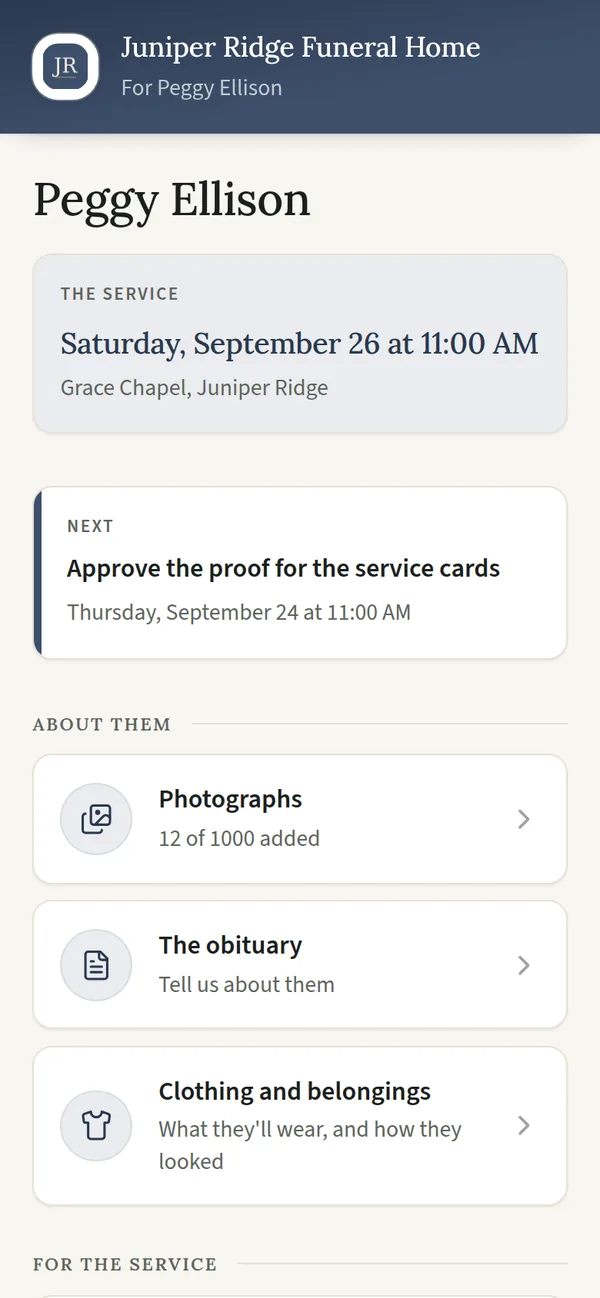
The family portal on a phone, headed with Juniper Ridge Funeral Home's own name and monogram: the service date and place, what is due next, and the things the family can do.
Your families see your name, not ours. The family's page carries your home's own name, mark and color. Continuum Aftercare appears nowhere on it.Real screens from the product. The homes and families in them are invented.

The problem, twice over

It is midnight, and there are forty attachments from six addresses.

Photographs arrive by email and by text, from a daughter, a son, a sister and a grandson, some of them twice. The obituary comes in three versions. One sibling asks about the hymns and another was told something different, and you answer the same question four times.

Then the service ends, and most families hear nothing more from the home that served them. They are left to remember on their own, in the year it is hardest, and the people who carried them through the worst week fade to a name they half remember.

A funeral is a moment. Care is a relationship. None of it is what your case-management system is for.

An illustration of the inbox this replaces, not a screen from the product.

The Arc · five connected stages

From a person's own wishes to the words delivered years later.

A continuous service for your families, anchored by the people who know them. Each stage carries the care and identity of your funeral home forward.

01

REMEMBER MEBefore the call

People plan with you before anybody has died.

In pilot with founding homes; not yet broadly available.

A private space in your home's name where a person writes down their wishes, their own obituary and letters for later. They start it themselves, from a link you share, and the day they die it is already the case: nobody is asked what they wrote down.

  • Their own obituary, kept in their own words—unchanged.
  • Instructions, wishes and sealed letters for the people they love.
  • You see that they are writing, never what: it is theirs while they live.
  • A pre-need conversation they begin, at their own pace, without a sales call.
Elena's story — in hospice, she records her wishes in her own words and leaves a sealed letter for her daughter. Remember Me, as the person herself uses it. (1:16)
02

THE CASEThe days around a death

One link, instead of forty attachments.

The next of kin gets one link they open on their phone, and can invite the rest of the family. Everything they send arrives in one place your staff work from. No app to install, no account, no password to forget three days after a death.

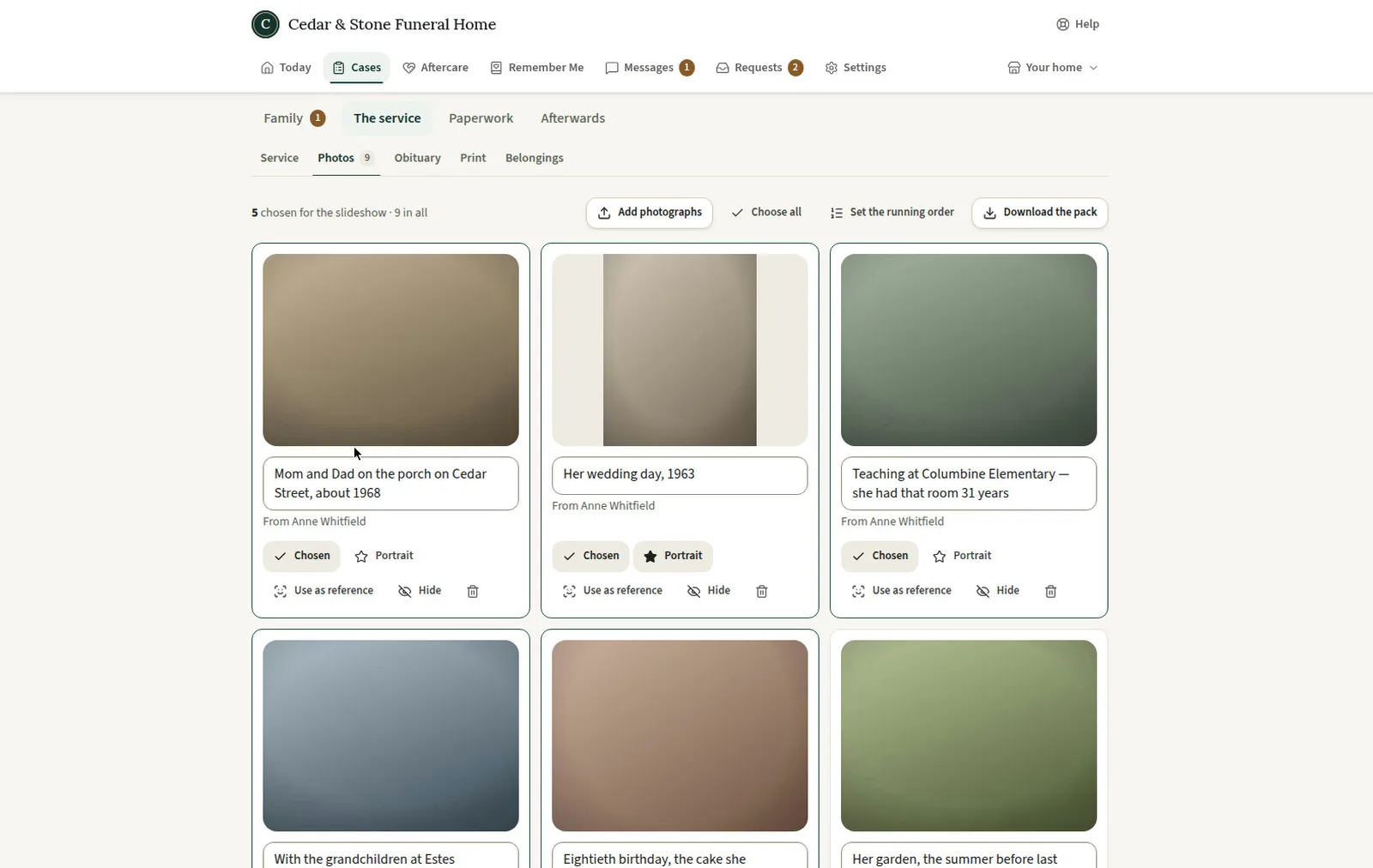
  • A photograph bin for up to a thousand; the family picks the slideshow, and the pack downloads numbered, in order, with captions.
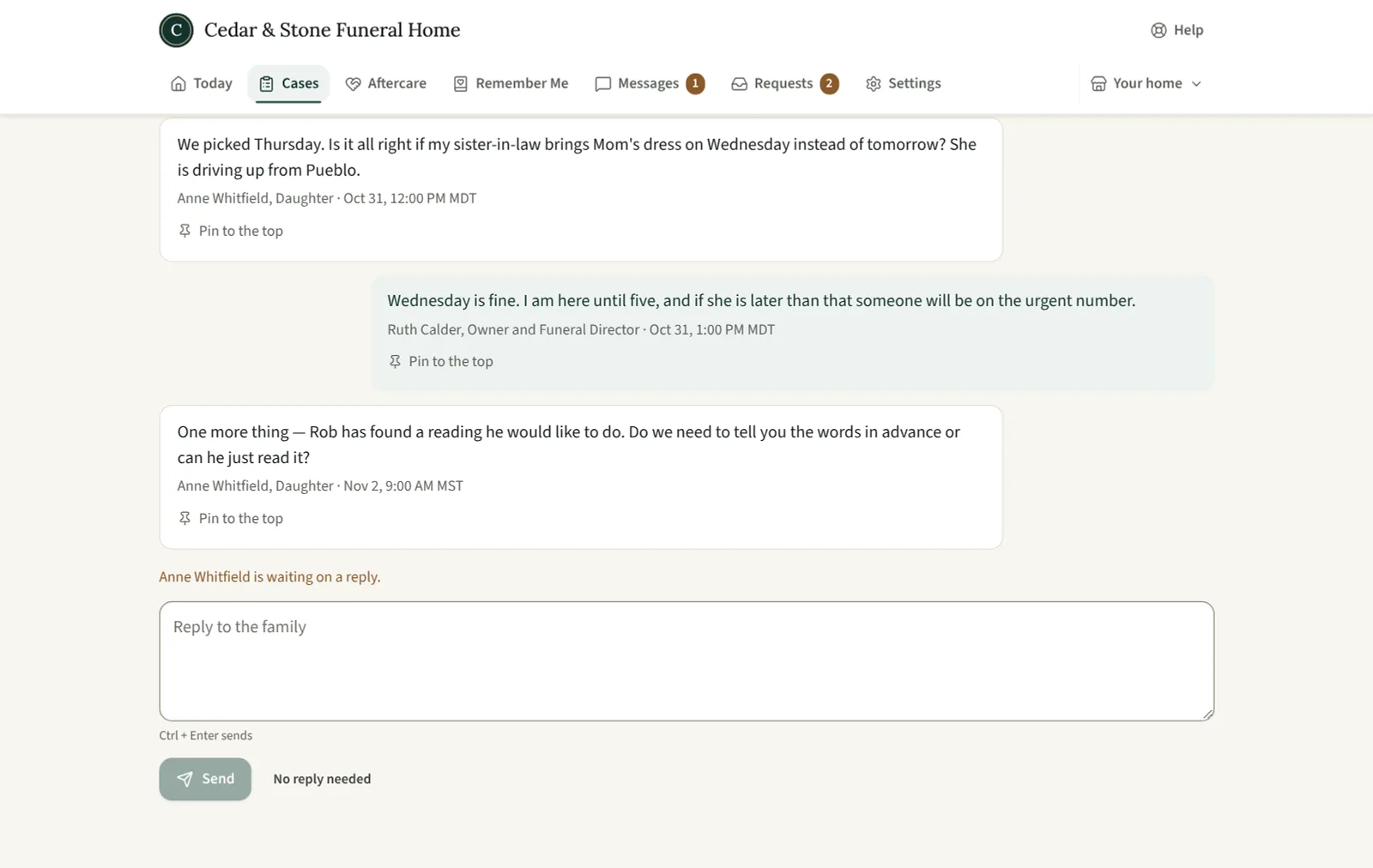
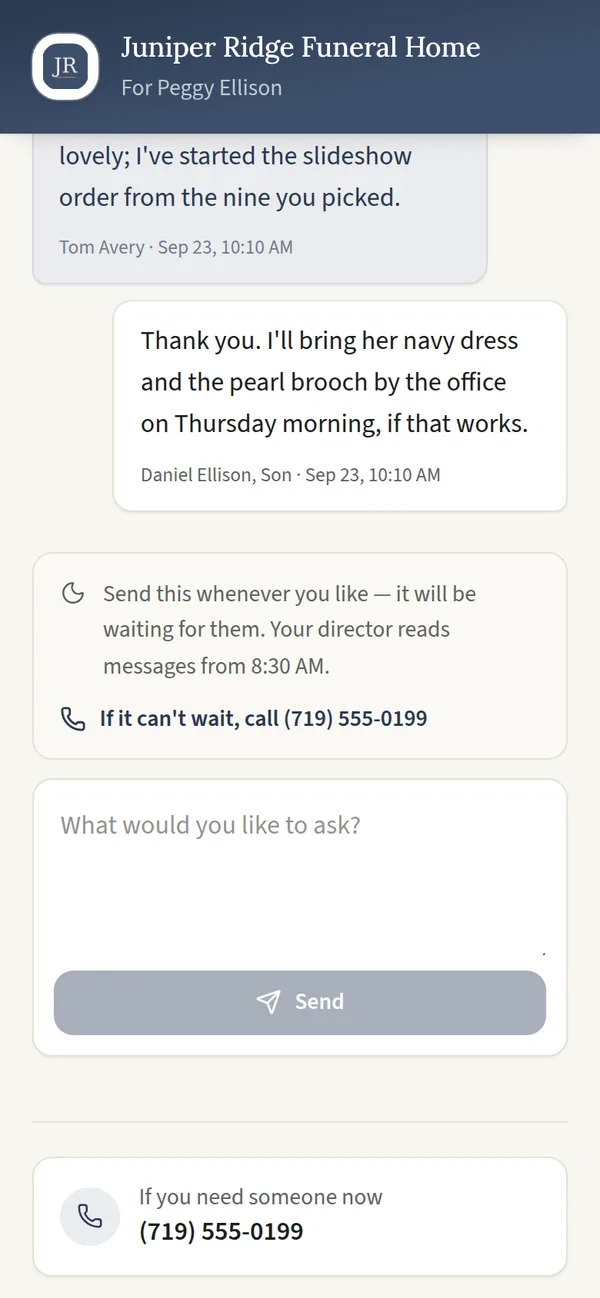
  • One thread the whole family shares, so you answer once. Late at night they are told when you will read it, with your 24-hour number beside it.
  • A timeline in plain words, built from your standard schedule the moment there is a service date.
  • The obituary in named fields, forms signed from home, and prayer cards and orders of service that fill themselves from the case.
  • Certificate deadlines counted from the moment the person comes into your care, using your state's rules.
  • One page each morning across all your cases: who is waiting on a reply, what went past due, which case has no date.
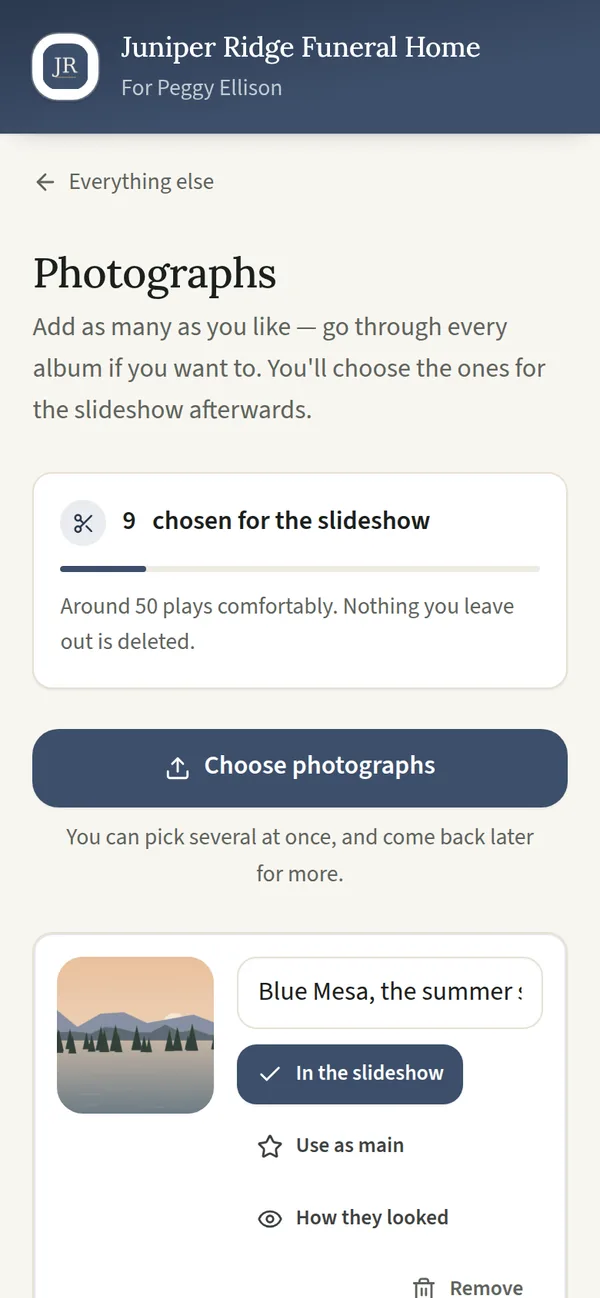
The family portal's Photographs page on a phone: nine chosen for the slideshow, a Choose photographs button, and each picture with its caption.
The family adds photographs on a phone; your staff see who sent each one and download the pack.
The family portal's message thread on a phone, late at night: a note says the message will be waiting and the director reads messages from 8:30 AM, with the 24-hour number beneath.
One conversation for the whole family. Late at night, they are told when it will be read, and who to call if it can't wait.
03

YEAR OF AFTERCAREThe first year

A year in their lives, without a staff hour.

Closing a case asks the family whether you may keep in touch. If they say yes, check-ins go out in your name at one, two and three months and at the year, and a card signed by your staff arrives at the month—printed and mailed by us. Nobody at your home has to remember to send any of it.

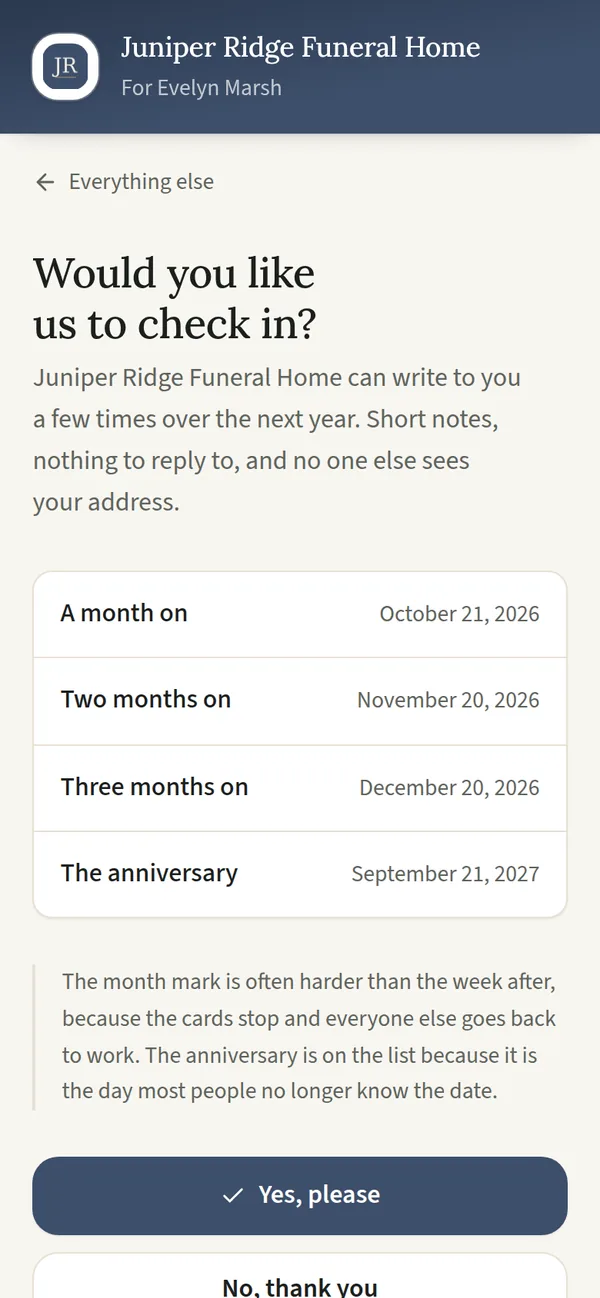
  • Nothing is sent until the family says yes, shown the actual dates, beside a no of the same size.
  • Their person's birthday, the first holidays and the anniversary, if they would like a note on those days.
  • A few gentle questions about the person, at the pace they choose, kept private unless they put the answer in the book.
  • Every note goes at mid-morning where your home is, never at three in the morning.
The family portal asking whether the funeral home may check in: the four actual dates listed, a Yes, please button and a No, thank you button of the same size.
What the family is asked: the actual dates, a Yes and a No of the same size, and nothing sent without a yes.
04

THE BOOKA keepsake, in their hands

Their memories, made into something they can hold.

Through the year, the family and their friends write into a memory book: stories, photographs, the eulogy. Friends need no link of their own, only the page the family shares.

  • Families choose what belongs in the book, then approve it page by page.
  • We have it printed, bound and shipped to them around the first anniversary.
  • The book carries your home's name on the back.
05

LETTERS TO DELIVERYears later

A promise that can reach years—and decades—ahead.

A person can write to the future: words delivered in your home's name on birthdays, anniversaries, graduations, weddings and other chosen milestones.

  • Letters stay sealed and unread until the day they were written for—by your staff too.
  • Delivered by email, or on paper: we print, seal and mail those for you, so your staff never handle them.
  • Every letter left for one person waits behind one link: the ones that have arrived, and the ones still to come.

What’s included

Everything it does, on one page.

The Arc is the shape of it. This is the inventory: every piece a home gets, grouped the way the work falls. Each line is in the product today, and each piece is yours to switch off for your families if you would rather not use it.

The days around a death

The case

  • One link for the next of kin, by text or email, who invites the rest of the family. No app, no account, no password.
  • A photograph bin for up to a thousand. Duplicates are spotted, the hidden location data is removed, the family picks the slideshow, and the pack downloads numbered and captioned.
  • The obituary in named fields, read and approved by you before it prints.
  • Hymns, readings and who will carry; the clothing and belongings; each speaker's eulogy, written in their own time.
  • A choice of service times you have already confirmed, and the gatherings the family would like, each confirmed by you.
  • One message thread the whole family shares. Your office hours are shown, never enforced, with your 24-hour number beside them.
  • A timeline in plain words, built from your standard schedule the moment there is a service date.
  • Death certificate details given by the family on their phone, and the deadline counted from the moment the person comes into your care, to your state's rules.
  • Your own PDF forms, filled in from the case and signed on the family's phone.
  • Seven print layouts at trade sizes, prayer cards to orders of service, filled from the case, with the family's approval of the proof recorded.
  • A document shelf: what the family sent in, what you share back, and the internal papers they never see.
  • The family's own notebook: a guest list, songs, readings and private notes they keep for themselves.

What your staff work from

Your home

  • One page each morning across every case: who is waiting on a reply, what went past due, what is happening this week, and which case has no date.
  • Your public page, in your own words, with your policies, the questions families ask and a request form. A death today and a plan for someday land apart, so the right call is made first.
  • A showroom: a photograph of each casket, urn and marker with its number, so a family can say "3, 7 and 9" before they visit. Prices are never shown to a family.
  • Your staff-only price sheet, and your own list of the people you recommend: monument makers, celebrants, florists.
  • Your verses, prayers and closing lines, kept once, so they stop being copied from a Word file.
  • Your staff, with roles, invited by a link; an access log you can read; and Help from every screen, which brings the screen along.
  • Bring your case list in from a spreadsheet, with a preview before anything is written. Export any case as a folder, and every case as a CSV.
  • Several locations on one contract and one invoice, each working as an independent home.

After the service

The first year

  • Check-ins at one, two and three months and at the year, in your name, once the family has said yes to the actual dates.
  • A note on their person's birthday, the first holidays and the anniversary, if the family would like one.
  • The one-month card, signed by your staff, printed and mailed by us.
  • Questions about the person, up to one a day at the pace the family chooses, with their answers kept private unless they put them in the book.
  • Recipe cards, a page of their family, and a note on a partner's wedding anniversary.
  • Families can answer by text, and what they write is kept for whoever sent it.

At the anniversary

The book

  • Stories, photographs and the eulogy, written into the book through the year by the family and their friends.
  • Friends need no link of their own, only the page the family shares.
  • The family approves it page by page, and sees a proof before it is printed.
  • Printed and bound in hardcover and shipped around the first anniversary, with your home's name on the back page. $85 per book, billed to your home and never to the family.

Years later

Letters

  • Written for a date or a milestone: a birthday, an anniversary, a graduation, a wedding.
  • Sealed until the day, from your staff and from us too.
  • Delivered by email, or on paper: we print, seal and mail those in your home's name, and your staff never handle them.
  • Every letter left for one person waits behind one link: the ones that have arrived, and the ones still to come.

Before the call

Remember Me

In pilot with founding homes

  • A private space in your home's name, which a person starts from a link you share, at their own pace.
  • Their own obituary, their wishes and their instructions, in their own words and never rewritten.
  • Letters for the people they love, sealed; up to three of them on paper.
  • You see that they are writing, never what. The day they die, their plan is already the case, and nobody is asked what they wrote down.

What it does for your home

Fewer hours in the four days. Your name in the years after.

Not a campaign: a relationship that does not expire. Continuum is the infrastructure, not the face. Families see the home that served them, and the work of staying in touch runs on its own.

$169 a month for each location, and $7 for each funeral you serve. Your families pay nothing.

  1. 01

    Hours back on every funeral

    The photographs, the obituary, the forms and the questions arrive in one place, already sorted. You answer the family once, and the timeline, the photo pack and the printed pieces build themselves from the case.

  2. 02

    A year of care, with no staff hours

    Check-ins, the one-month card and the book go out in your name on their own schedule, once the family has said yes. We print, address and mail everything on paper. Nobody at your home has to remember.

  3. 03

    Your name, when they next need a funeral home

    The book they keep carries your name on the back, and letters written years ahead arrive from your home on birthdays, graduations and weddings. The families you served keep knowing where to find you.

  4. 04

    Pre-need conversations they start

    Share your Remember Me link on a card or on your website. People write down their own wishes with you, at their own pace, and the day the call comes, their plan is already the case.

Clear by design

Some promises should be specific.

Your home has earned the family's trust. The service should protect it, not borrow it.

  • Their words stay theirs

    A self-written obituary stays unchanged. A person's voice is not rewritten for them.

  • Private means private

    Families control privacy. Private content stays in its own space and never leaves that space.

  • A sealed promise stays sealed

    Letters remain unread until the chosen delivery date; no one opens them early.

  • Your home is the name they see

    The home receives the credit and stays in the relationship. Continuum remains invisible to families.

Security and privacy

In plain words, because your families' details deserve them.

You are the controller of your families' information; we hold it for you and act on your instructions. Every statement here was written against the code that makes it true, and changes when the code does.

Data processing agreement

A data processing agreement, written against the code rather than from a template, is available on request for you and your insurer.

Ask for a copy
  • Family links are stored as a fingerprint

    We keep only the SHA-256 hash of each family's link, never the link itself. A link reaches exactly one case and stays open while the family keeps using it; one nobody has opened for 90 days stops working on its own (a year and a month, for a family in aftercare), and you can switch any link off in one click.

  • Photographs and social security numbers are encrypted

    With AES-256-GCM, before they are written to the database. The key is never stored in the database, and backups are encrypted as whole files.

  • Your home's data is walled off from every other home's

    Every record carries your home, and every staff request is filtered by the home of the person signed in, never by anything in the request. Automated tests try to cross that line and must fail.

  • Every time we look, it is written down first

    Our own staff reach your data only through an access list that is empty by default, and each look is logged, naming who and what, before the data comes back. Your home's owner can read every entry in the console.

  • Your data leaves when you say so

    Any case exports as a folder of photographs and plain text that opens without this software, and still exports after you cancel. Erasing a case destroys the encrypted photographs themselves, not just the reference to them, and copies in backups age out with the backups.

  • Nothing is sold, tracked or used for training

    No analytics, no advertising, no tracking across other sites, and none of it is used to train any AI model. Photographs, messages and vital statistics reach none of the services we send mail or bills through, though a check-in email does name the person who died.

Where a photograph was taken stays private. Phones write the location into every picture, and a photograph of someone in their garden is taken at their house. We take that hidden camera data out of every photograph as it arrives, without re-compressing it, so the photo pack you send a print shop says nothing about where anybody lives.

Pricing

One price per location, and a little per funeral.

Aftercare, email and texting are included. No activation fee. Your families pay nothing, ever.

Monthly

$169 / location / month

+ $7 per funeral served

A home with ten funerals a month pays $239.

  • Family portal, photos, obituary and print studio
  • Grief aftercare by email and text, in your name
  • A card from your staff at one month, printed and mailed for you
  • Texts and email to families at no extra cost
  • Death-certificate deadline tracking, counted from the moment they come into your care — set to your state's rules.
  • Case export, and a CSV of every case
Start a free trial

30 days free, and no card needed to start.

Annual

$1,690 / location / year

Two months free, + $7 per funeral

A home with ten funerals a month pays $2,530 a year.

  • Everything in monthly
  • One invoice a year
Email us a question

Choose annual billing when you subscribe.

On either plan, a pre-need file is not billed until it becomes a funeral and no funeral is billed twice, several locations share one invoice, and funerals during your trial are counted, then waived.

Beyond the plan

  • The memory book, priced separately — the family's year of photographs and words, printed, bound and shipped to them for you around the first anniversary of the service. $85 per book, billed to your home when it is sent; never to the family.

Questions

What directors ask us first.

Anything else, write to help@continuumaftercare.com.

Do our families need an app or an account?

No. They get a link — sent by email, and by text wherever a home has texting set up — and it opens in the phone's browser. There is nothing to install and no password to choose, because a registration form in the week of a death is where people give up.

What if a link ends up with the wrong person?

Switch it off from the case in one click and send a fresh one; the old one stops working at once. Links also close on their own once nobody has opened them for 90 days, and only a fingerprint of each link is stored.

Does it replace our case-management system?

No, and it is not meant to. Keep your contracts, your price list and your records where they are. Continuum Aftercare is for the collaboration with the family, which that system was never built for.

Will our name or our prices appear anywhere a family can see?

Your name, yes: the family portal carries your home's name, mark and color, and ours does not appear on it. Your prices, never. There is no setting that would show a price to a family or on your public page.

How do families find us before there is a case?

Each home gets a public page with its own words, its policies and a request form, which you can link from your own website. A request lands with your staff; nothing is opened until one of you accepts it.

Does it help with prayer cards and orders of service?

Yes. There are seven ready-made layouts at real trade sizes: prayer cards, bookmarks, folded and single-sheet orders of service, an obituary page, register pages and thank-you cards. Most of each layout fills itself from the case, and it prints from any browser with a standard bleed.

What happens to our data if we leave?

Export any case as a folder of photographs and plain text that opens without us; exports keep working after you cancel. Families already enrolled in aftercare keep their check-ins. While you are with us, nothing about a case is deleted on a timer: how long you keep records is set by your state and your insurer, so it is your decision, not ours.

Is the trial really free?

Yes. The trial runs 30 days from the day you register, with no card needed to start. That is long enough to work real cases and see your first families' check-ins scheduled, so you decide with evidence in hand. Funerals you handle during the trial are counted, so you can see them, and then waived.

Be there before the call—and long after the service.

See how the Arc can help your home remain a trusted presence for the people you serve, in your name and on their terms.